
Most local-SEO advice you'll read assumes you're competing in a major metro: Toronto, Vancouver, Calgary, Montreal. The local pack in those markets has dozens of established competitors, hundreds of reviews per business, and Google's local algorithm has plenty of data to draw on. None of that holds in Pemberton, Yarmouth, Whitehorse, or rural Lambton County. The playbook has to change.
Service-area businesses, not storefronts
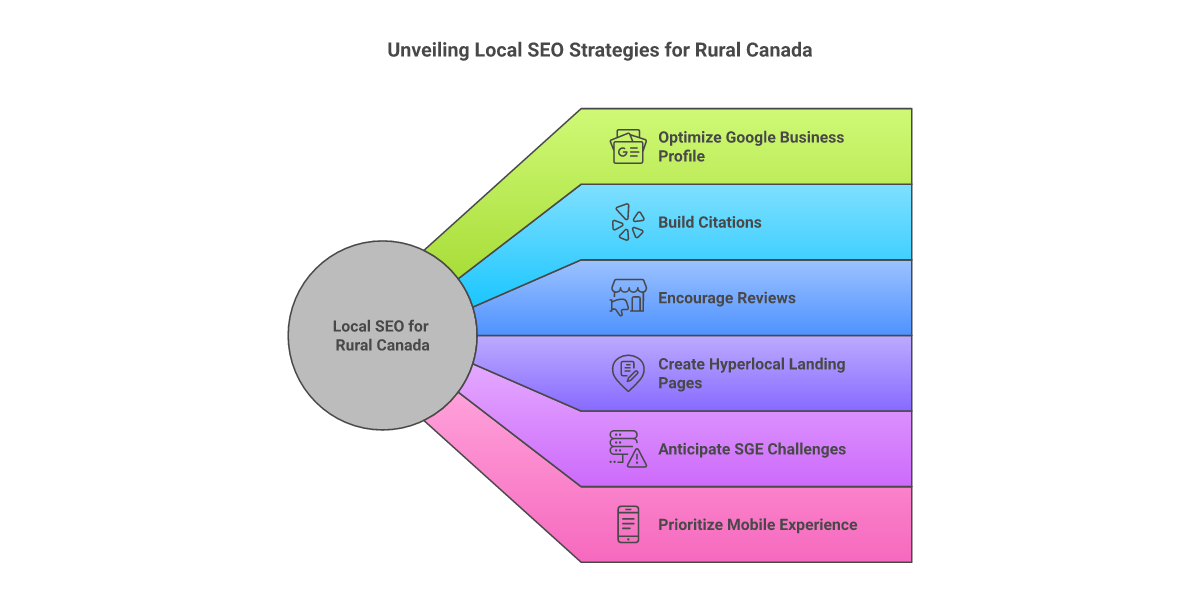
Many rural Canadian businesses don't have a public-facing storefront — contractors, mobile services, agricultural suppliers. Google Business Profile supports a "service area" model where the business hides its address but specifies the regions it serves. This is the right setup for most rural businesses, and the optimization rules are slightly different: you can't lean on physical-location signals (storefront photos, walk-in reviews), so consistency and accuracy of service-area definition matters more.
Citations on the right Canadian directories
The international citation directories you see on US-focused local-SEO blogs are mostly noise in Canadian markets. The directories that actually carry weight: Yelp Canada, YellowPages.ca, 411.ca, the Better Business Bureau, your provincial chamber of commerce, and any regional industry-specific directory. Five high-quality Canadian citations are worth more than fifty low-quality international ones.
Reviews that mention the actual town
Generic positive reviews don't move rankings the way location-anchored reviews do. A review that says "great service in Squamish — fast response after our basement flooded" is a stronger ranking signal than the same review without the location. The right ask of customers post-service is for a review that mentions where they were and what work was done. This is harder than asking for a 5-star rating, but it produces a stronger Map Pack.

Hyperlocal landing pages
If you serve five towns within a 60km radius, you need five landing pages — one per town — each with genuinely useful, town-specific content. "Plumbing services in Squamish" with stock photos of unrelated work in Whistler is the doorway-page anti-pattern Google has been suppressing for over a decade. Town-specific testimonials, town-specific service notes (different bylaws, different building age, different seasonal patterns) make these pages work.
Mobile-first, not mobile-also
Rural Canadian users skew phone-only at substantially higher rates than urban ones. If your local landing pages aren't fast, scrollable, and tap-friendly on a five-year-old Android, you're losing the audience before they read your value prop. The Search Generative Experience, which has rolled out unevenly in less-populated regions, also amplifies the phone-first reality — its results are denser and AI-summarized, and only the most credible sources get cited. This is the audience CIMA's local-SEO members serve daily; see our member directory for agencies working in this space.
Keep reading
Browse the full blog index, jump to our resources, or look up terms in the glossary.