
The end of third-party cookies has been the longest goodbye in adtech history — promised, postponed, partially walked back, then quietly resumed. By 2026, the practical reality for Canadian publishers is that cookie-based audience addressability is a fraction of what it used to be, Privacy Sandbox APIs are live but uneven, and the publishers who invested early in first-party data are pulling away from the ones who didn't.
First-party data is the only permanent answer
Newsletter signups, registered accounts, declared-interest preferences — the audiences a publisher can reach because the user has an actual relationship with the publication. Canadian publishers building first-party audiences have measurable yield premiums over their cookie-only inventory, and those audiences survive every iteration of platform privacy change because they're consented, declared, and owned.
Contextual targeting is back
The targeting model that predated behavioural — placing ads against relevant content rather than identified users — is having a renaissance. Modern contextual systems use AI to classify content semantically, going beyond keyword matching to actual topic understanding. For Canadian publishers, this is genuinely useful: Canadian context (provincial topics, bilingual content, Canadian regulatory references) classifies cleanly and creates differentiated inventory.

Privacy Sandbox: Topics, Protected Audience, attribution
Google's Privacy Sandbox APIs — Topics for interest signals, Protected Audience (formerly FLEDGE) for remarketing, Attribution Reporting for conversion measurement — are now production-grade and integrated into the major SSPs and DSPs. Canadian publishers should be testing them, but with realistic expectations: the APIs work well for some use cases (broad interest targeting) and poorly for others (precise frequency capping). They're a partial replacement, not a 1:1 substitute.
Server-side tagging
Moving analytics and ad-tagging server-side gives publishers more control over what data leaves their environment, helps with browser-side privacy restrictions (ITP, Total Cookie Protection), and improves page performance. The setup cost is real — you're running a tag-management container on your own infrastructure — but the operational improvements compound. Most Canadian publishers above mid-size now operate at least partial server-side tagging.
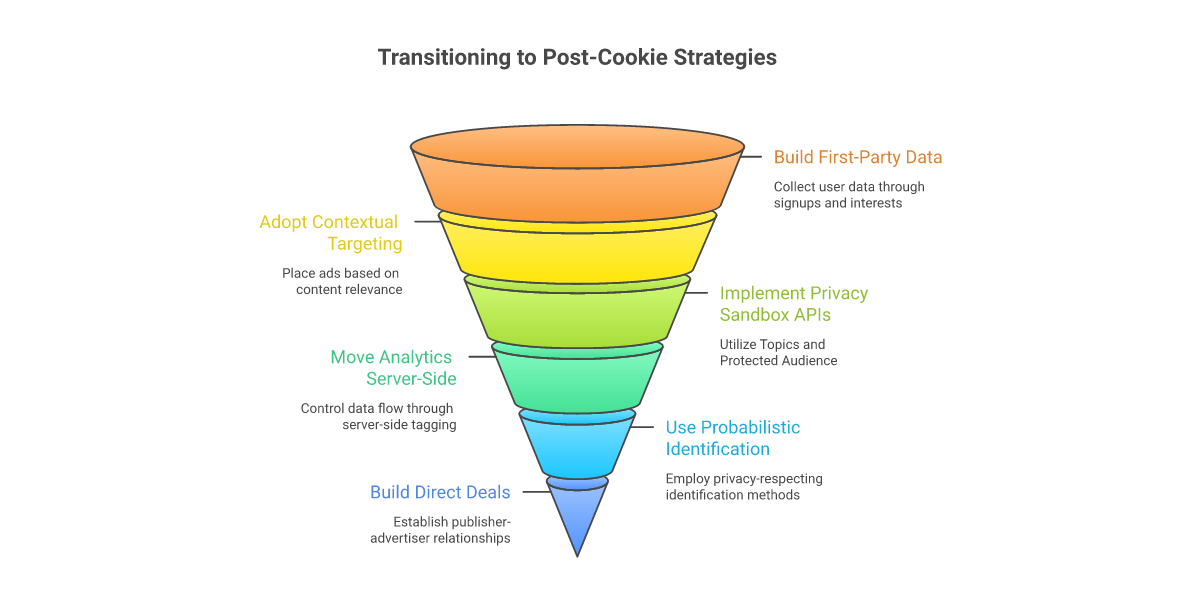
Direct deals over open programmatic
The economic case for open programmatic was that it scaled audiences across publishers cheaply. As cookie addressability fades, that scaling has weakened, and the value of direct relationships between publishers and advertisers is rising. Canadian publishers building direct-deal pipelines — usually around premium first-party audiences and vertical content franchises — are getting CPM premiums that open auctions don't pay anymore.
Keep reading
Browse the full blog index, jump to our resources, or look up terms in the glossary.