
Canadian digital marketing agencies serve a steady stream of US clients — partly because the talent pool is competitive, partly because the CAD-USD rate makes Canadian rates attractive, and partly because Canadian time zones cover both US coasts. The work itself is the same. The administrative layer underneath is meaningfully different, and getting it wrong costs Canadian agencies real money.
Currency: invoice in USD, plan in CAD
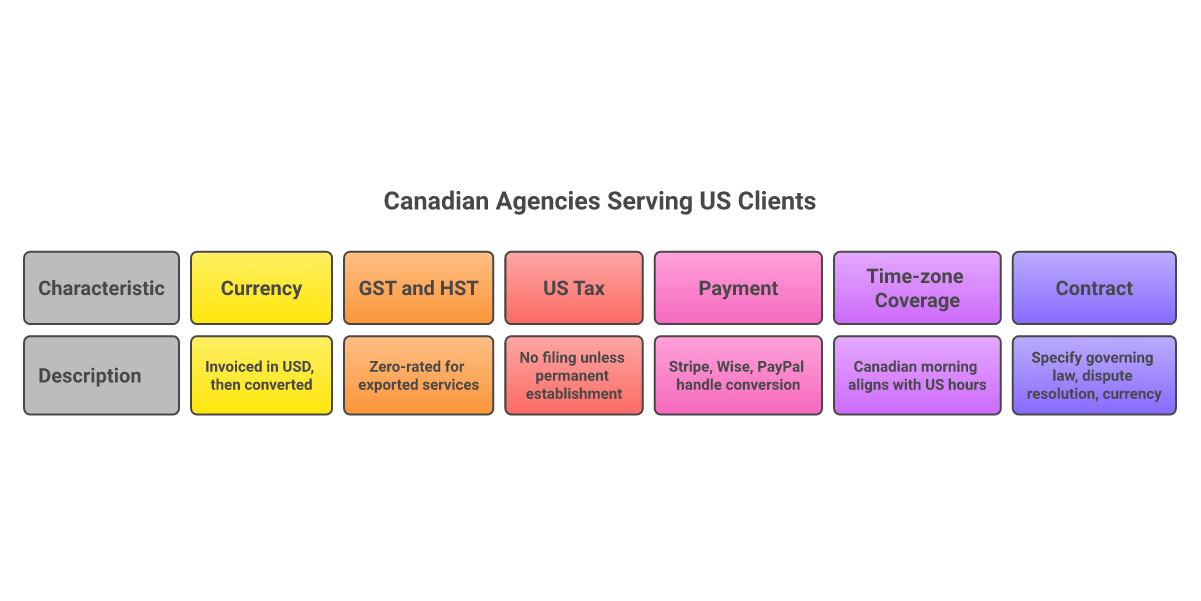
Most Canadian agencies invoice US clients in USD. The client expects USD pricing, your competitors are quoting USD, and the conversion friction is yours to manage. The right setup is a USD operating account (Wise, RBC USD, or a Stripe USD-denominated payout) that holds funds until you choose to convert. Converting 100 percent of every invoice on receipt is a costly habit when your overhead is in CAD anyway.
GST and HST: zero-rated for non-Canadian clients
Services exported to non-resident clients are generally zero-rated under the Excise Tax Act — meaning you don't charge GST/HST, but you can still claim input tax credits on your business expenses. The documentation matters: keep evidence the client is non-resident (incorporation docs, US address, paid via US bank), and record the zero-rated treatment correctly on your invoices. Charging GST to a US client is a soft error you can usually credit back; missing input tax credits because you treated the work as exempt rather than zero-rated is a harder error to recover from.

US tax: usually no obligation, sometimes a trap
Most Canadian agencies serving US clients have no US filing obligation — they're providing services from Canada to a US recipient, with no permanent establishment in the US. The traps are when an agency opens a US bank account that creates nexus, sends staff to physically work at a US client site for extended periods, or accepts equity in a US client. None of these create instant exposure but each can pull you into US filing requirements faster than the agency owner expects. When in doubt, get a real cross-border accountant — not the one who handles your domestic books.
Time zones are an asset
A Toronto-based agency starts the day three hours before California opens and an hour before New York. A Vancouver-based agency aligns cleanly with Pacific clients and handles East Coast urgent items by lunch. This is genuinely useful to US clients and worth pricing in. The reverse — a Vancouver agency taking on East Coast clients with 9am ET standups — is the configuration that burns agency staff fastest.
Contract law: pick a jurisdiction explicitly
The contract should specify which jurisdiction governs disputes. Canadian agencies should default to a Canadian province (usually their home province), and resist clients' attempts to push to Delaware or California unless the engagement is genuinely large enough to justify the legal complexity. Specify currency, payment terms in business days not calendar days, and what happens to deliverables on early termination. The CIMA Standards emphasize transparent pricing and clean transitions — this is where it shows up in the contract.
Keep reading
Browse the full blog index, jump to our resources, or look up terms in the glossary.